
A field guide for Virginia canvassers • 2026 Cycle
Knocking Doors in Virginia
Everything a first-time canvasser needs and everything an organizer has to have ready — written to work in any city or county in the Commonwealth. Bring your own slate; the rest is here.
Printing this? Don’t print the web page. Scroll down to Print the checklists for proper one-page sheets built for a clipboard — including a door log you can write on. Every sheet has blanks for your own committee, slate and staging address.
Start here: your locality
Three things on this page are different in every city and county. Get them before your first shift — everything else on this page is the same statewide.
1. Your city or county committee
Your unit is who assigns your turf, prints your literature and answers the phone when a door goes wrong. The Republican Party of Virginia keeps a directory of every unit chair, with email and website, for all 133 cities and counties.
Find yours: virginia.gop/find-your-local-gop.
2. Your candidates
Congressional, local and school board races differ by locality, and so do the flyers. Get your slate and your printable flyer from your own city or county committee — the directory above links to each unit’s site. Don’t hand a voter a flyer from another jurisdiction; half the names will not be on their ballot.
If your unit has no flyer yet, that is the first thing to ask the chair for.
3. Your registrar
Early voting dates are set by state law and are the same everywhere. Early voting hours and locations are set locally and are not — some localities add Saturdays, some close for Columbus Day, some run a single office and some run several.
Look up your general registrar’s office and hours at the Virginia Department of Elections before you quote hours at a door.
First time knocking?
Ninety seconds of orientation before you read the packing list.
What the shift actually looks like
You will go out in pairs from a staging location, with a walk list of assigned addresses. A typical shift is two to three hours. Most doors will not answer — that is normal, not failure. The doors that do answer take thirty to sixty seconds, not ten minutes.
Your job is not to win an argument. It is to identify who supports your candidates, leave good information behind, and write down what you heard.
The door, step by step
1. Knock or ring, then step back from the door. It puts people at ease and it keeps you out of the way of a screen door.
2. Give your first name and say you are a volunteer with your local Republican committee — name it.
3. Ask your question, hand over the flyer, listen.
4. Thank them by name if you have it, and go.
5. Log the result on your tally sheet before you reach the next house. You will not remember it later.
A script you can say out loud
“Hi, I’m [your first name]. I’m a volunteer with the [your city or county] Republican Committee — I’m just dropping off information on our candidates for the November 3rd election. Are you planning to vote this year?”
That is the whole thing. If they are friendly, ask whether they know about the three constitutional amendments on the back of the ballot and hand them the amendments card. If they are busy, hand them the flyer and let them go. If they want to argue, thank them and move on — you have more doors to reach and nobody has ever been argued into voting.
What canvassers should bring
Print the sheet, tick as you pack. The first four are the true must-haves — everything else is nice to have.
Core materials
□
Walk list — your assigned addresses for the day. Your unit chair or precinct captain generates these; find your unit if you don’t know who that is.
□
Candidate flyer — your own locality’s slate. Get it from your city or county committee, not from another unit’s site.
□
“Vote No” amendments card — plain-language explainer for all three statewide amendments. Printable cards and handouts.
□
Talking points card — short answers to the questions you will actually get asked. Read and print the talking points.
□
Voter contact / tally sheet — to log every door: support, undecided or oppose; will vote, needs a ride, needs information; or no answer. Use whatever tool your unit runs — PrecinctsPro, MiniVAN, a spreadsheet — or just take notes on paper. Recorded badly beats not recorded.
□
Volunteer sign-up card — so a supportive voter can sign up on the spot. Use your unit’s own sign-up page; if it has none, the RPV directory gets them to a chair who can take a name.
□
Early voting & Election Day card — the statewide dates are in the box below. Add your locality’s early voting site and hours from the registrar lookup before you print.
□
“Sorry we missed you” door hangers — for the no-answers, which will be most of them. Download the printable door hangers (PDF) — two per page, cut and punch the marked circle.
Identification & logistics
□
ID badge or lanyard — if your unit has them, ask the office. It matters more than you would think at an unfamiliar door.
□
Clipboard — a walk list flapping in the wind is a miserable afternoon.
□
Pens — bring extras. They walk off.
□
Field director’s phone number — written down, not just in your head. Who you call if something at a door goes sideways.
Optional but useful
□
Yard signs — request them from your unit and keep a few spares in your trunk. People ask, and a sign placed today is a sign up for two months.
□
Donate QR code — your unit’s own donation page. Keep it separate from the volunteer card; they are two different asks.
Personal supplies
□
Water bottle
□
Sunscreen and bug spray — September and October in Virginia.
□
Comfortable, broken-in shoes — you will cover more ground than you expect.
□
A few dog treats — the single best trick for a house with a dog in the yard.
□
Phone charged — and a charger in the car.
The rules that matter
Most of canvassing is common sense. These are the ones worth memorizing — and every one of them applies in every locality in Virginia.
✓ Always
✓
Step back after you knock. It reads as respectful and it keeps you clear of a swinging screen door.
✓
Go in pairs. Never canvass alone, even in a friendly neighborhood.
✓
Leave literature in the door. Wedged in the frame, on the handle, or under the mat.
✓
Log every door. Including the no-answers. A blank line is lost work for whoever walks that turf next.
✓
Report a bad address immediately. If a door turns hostile or a dog is loose, call your field director and let them flag it so the next volunteer is not sent there.
✓
Be honest when you don’t know. “That’s a good question and I don’t want to guess — it’s all on the website” is a perfectly good answer.
✗ Never
✗
Never put anything in or on a mailbox. Mailboxes are federal property and it is against the law — 18 U.S.C. § 1725. This is the rule people break by accident. Door, frame, handle, mat: yes. Mailbox: never.
✗
Never go inside a home. Not even when you are invited in. Talk on the porch.
✗
Don’t argue. Disengage politely. You cannot convert anyone at the door and you will burn the shift trying.
✗
Honor “No Soliciting” signs. Skip the house, mark it, move on. Some Virginia localities also have their own solicitation ordinances — ask your unit chair whether yours does.
✗
Don’t knock after dark. Daylight saving ends Sunday, November 1 this year — sunset drops to roughly 5 p.m. for the final push. Plan the last shifts accordingly.
✗
Don’t photograph or record residents. Ever.
✗
No campaign material near a polling place. Virginia keeps a 40-foot prohibited area around the entrance, statewide. Take the badge and the flyers off before you go in to vote.
Dates to have in your head
These are set by state law and are the same in every Virginia locality. Hours and polling locations are not — those are set by your local registrar, and a few localities run exceptions, so confirm yours before you quote them at a door.
November 3, 2026 general election
Fri Sept 18 – Sat Oct 31
Early voting in person, at your registrar’s office and any satellite site your locality opens. Hours vary by locality.
Fri Oct 23
Voter registration deadline (11:59 p.m.), and the last day to request a mail ballot (5 p.m.).
Sat Oct 24 – Election Day
Same-day registration is available; those ballots are cast provisionally.
Tue Nov 3, 6 a.m. – 7 p.m.
Election Day. Anyone in line at 7 p.m. is entitled to vote.
Look up a polling place or check a registration at the Virginia Department of Elections. Find your local registrar’s address and hours through the contact lookup. Your own unit’s canvass schedule lives on its site — find it in the RPV directory.
For organizers
The prep that decides whether a canvass runs well. Canvassers can skip this section.
Before the canvass
□
Walk lists pulled and assigned — split by turf, no two canvassers overlapping. Precinct captains can generate these.
□
Printed materials in stock — flyers, amendments cards, door hangers. Print your headcount plus a buffer — spoilage and walk-ups both happen.
□
QR codes tested — scan every code on every printed piece with an actual phone and confirm it lands on the correct live page. A printed QR code cannot be recalled.
□
Talking points reviewed — especially the amendments language — that is the piece most likely to trip a canvasser mid-conversation.
□
Badges and lanyards counted — plus spares.
□
Paper or app decided — tally sheets or a tracker such as PrecinctsPro, MiniVAN or Spoke. Pick one and brief everyone on it before they leave. Mixed methods produce unusable data.
□
Disclaimer confirmed — check with your unit treasurer that the “paid for by” line on every printed piece is correct for whoever is paying for the print run, before it goes to the printer.
Day of
□
Staging location confirmed — time, address and where to park, sent out the day before.
□
Buddy pairs assigned — nobody walks alone.
□
Turf maps ready — printed or loaded onto phones before anyone leaves.
□
Check-in / check-out — you should know who is out and when they are due back. The organizer sheet below has a roster for this.
□
Emergency contact list circulated — in hand before they head out, not texted mid-shift.
□
Water and snacks at staging — for before and after.
After
□
Collect tally sheets same day — or confirm the app data actually synced. Memory decays fast and paper gets left in cars.
□
Enter the data — into the voter file or CRM.
□
Flag the urgent responses separately — “needs a ride,” “needs information,” and anyone who offered to volunteer. Those need follow-up in days, not weeks.
□
Restock — based on what actually ran out, not what you guessed.
□
Two-minute debrief — what question kept coming up that the talking points did not answer? Fix the card before the next outing.
Keep the kit light.
A bag that is too heavy and a script that is too long both get abandoned in practice. The walk list, the candidate flyer, the amendments card and the tally sheet are the real must-haves; treat everything else as optional.
Laminate the reference cards.
Anything that gets reused across shifts — voting dates, talking points — should be card stock or laminated. They live in a bag in a hot car and they show it.
Print the checklists
Built for a clipboard, not a screen — white ground, minimal ink, and room to write. Every sheet is generic to Virginia: fill in your committee, your slate and your staging address in the blanks. Print on card stock if you can.
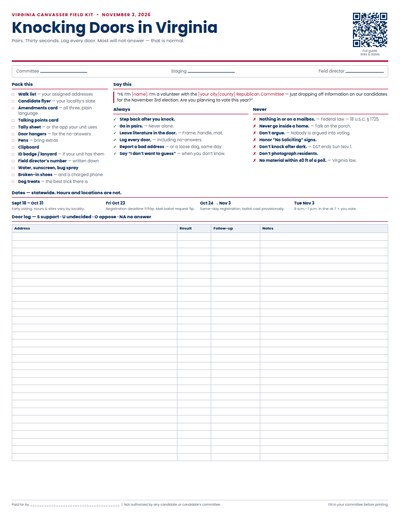
Canvasser Field Kit
One page: packing list, door script, the rules, the statewide dates, and a 16-row door log to write on.
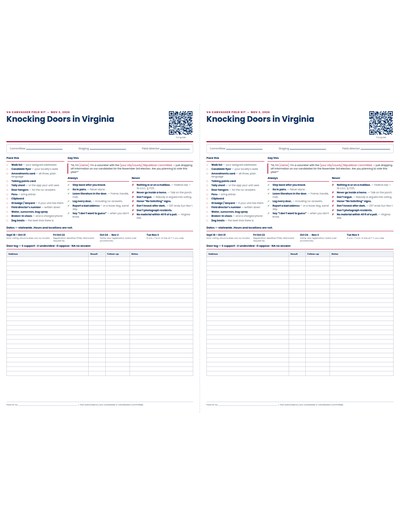
Field Kit, Two Per Page
The same sheet at half size, two to a page. Cut down the middle for a clipboard or a pocket.
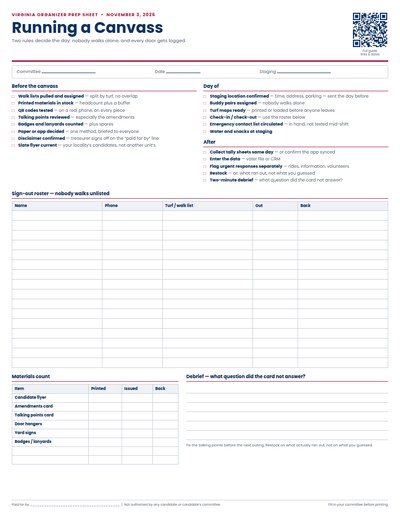
Organizer Prep Sheet
Before, day-of and after, plus a sign-out roster so nobody walks unlisted.
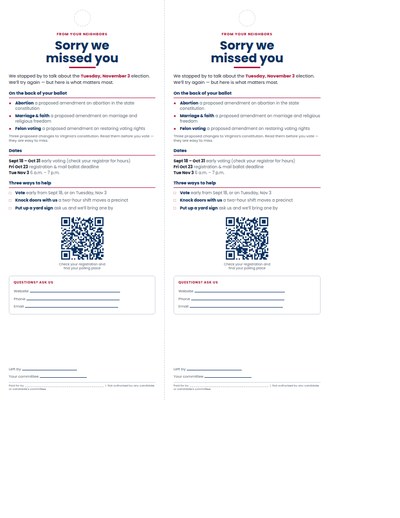
“Sorry We Missed You”
Two door hangers per page for the no-answers. Cut out and punch the marked circle.
Two things to do before a print run. Fill in the blanks — committee name, staging address, and the “paid for by” line your treasurer confirms. Then print one copy and scan the QR code with a phone. A printed code cannot be recalled.
Take this with you
Use this in your city or county
This guide was written by the Republican Party of Chesapeake and is offered to every Republican unit in Virginia. Copy it, paste it into your own site, put your name on it. No permission needed and no attribution expected. A worked example with one locality’s specifics filled in is the Chesapeake field kit.
Fill these in
□
Your committee’s name and contact — in the door script, on every printed sheet, and on the door hanger.
□
Your slate and your flyer — the one link this page deliberately leaves to you.
□
Your early voting site and hours — from your registrar. The dates are statewide; the hours are not.
□
Your “paid for by” line — whatever your treasurer says is correct for the entity paying to print.
Leave these alone
□
The mailbox rule — federal, and it applies everywhere in the United States.
□
Pairs, daylight, no arguing — these are not local preferences.
□
The 40-foot rule and the statewide dates — Virginia law, identical in all 133 localities.
□
The door sequence and the script shape — swap the names, keep the structure: short, honest, one question.